
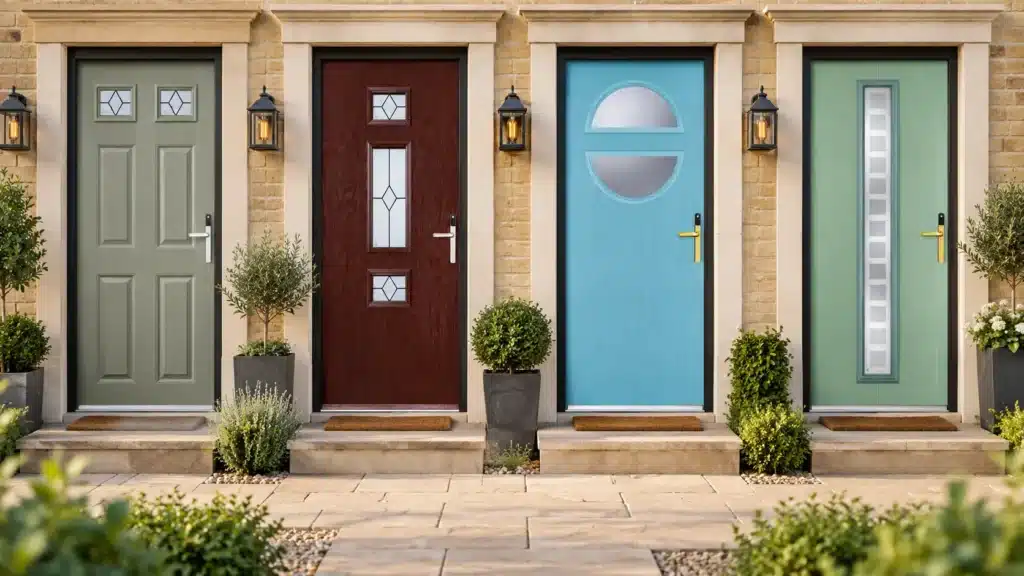
Choosing from Window Mart’s composite door range is largely about four things: colour, style, security and insulation. The right combination should suit the age of your house, work with the brickwork and windows, provide the privacy you want and make everyday access practical.
Window Mart’s online tool lets you compare these choices on a door before arranging a survey. You can change the door style, internal and external colours, frame finish, glazing, hardware and security upgrades, then view an indicative price.
Which composite door colours are most popular for UK houses?
Black, grey, blue, green and white are among the most popular composite door colours for UK homes. They are easy to coordinate with common brick, render and window-frame colours. Softer heritage shades such as Chartwell Green, Agate Grey and Duck Egg Blue suit cottages and period properties, while red and other stronger colours make the entrance more noticeable.
There is no single best colour. A north-facing entrance can take a warmer or brighter shade, while a door exposed to strong sunlight may look better in a colour that works with the surrounding masonry throughout the day. It is worth viewing samples outside rather than choosing under showroom lighting alone.
10 composite door colours to consider
- Black: a crisp choice for Georgian, Victorian and contemporary homes.
- Grey: works particularly well with white frames, modern render and grey window frames.
- Blue: a familiar front-door colour that sits comfortably with red brick and pale render.
- Green: suits traditional houses and homes with established planting around the entrance.
- White: keeps a small or shaded porch looking light and clean.
- Chartwell Green: a muted heritage shade often chosen for cottages and country-style homes.
- Agate Grey: softer than a dark anthracite-style grey and easy to pair with neutral finishes.
- Pebble Grey: a warm neutral for stone, cream render and understated schemes.
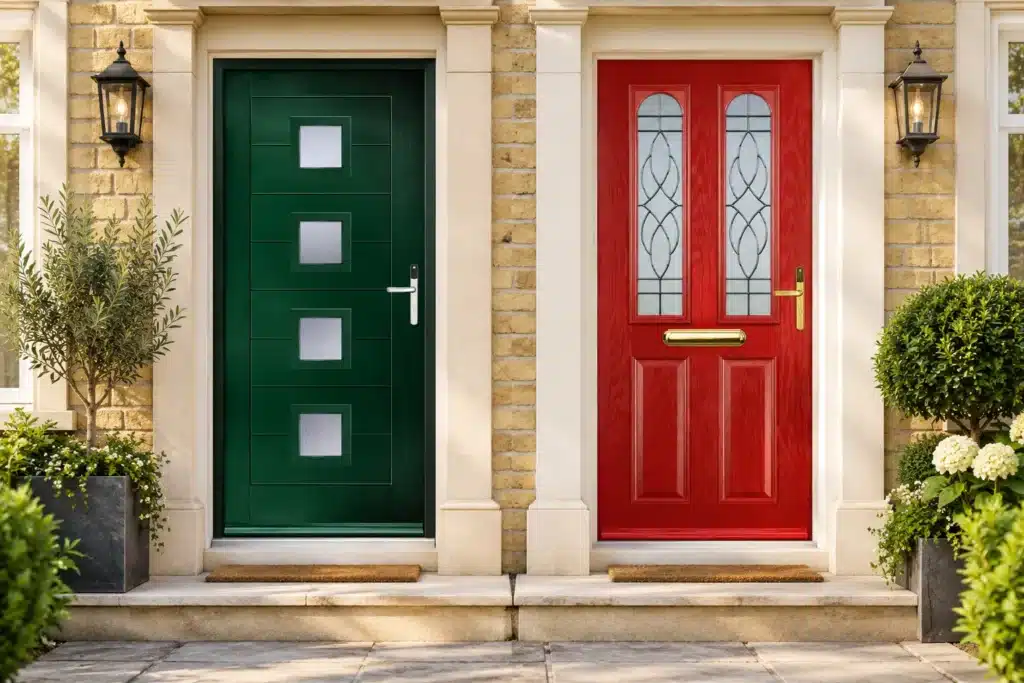
- Red: gives the entrance a clear focal point, especially against pale walls or traditional brick.
- Oak or Dark Wood: gives the appearance of timber without limiting you to a traditional panel layout.
The Window Mart Door Designer currently includes 19 door colours: White, Red, Green, Blue, Black, Oak, Dark Wood, Black Brown, Chartwell Green, Cream, Grey, Duck Egg Blue, Poppy Red high gloss, Agate Grey, Fern Green, Purple Violet, Turquoise Blue, Pebble Grey and Pastel Blue.
Can a composite door be different colours inside and outside?
Yes. Window Mart’s designer allows the external and internal door colours to be chosen separately. You could use a stronger colour outside and white inside, for example, so the hallway remains light. The frame also has its own finish choices, including White, Golden Oak, Mahogany, Cherrywood, Whitegrain, Black Brown, Chartwell Green, Cream and Grey.
What composite door styles are available?
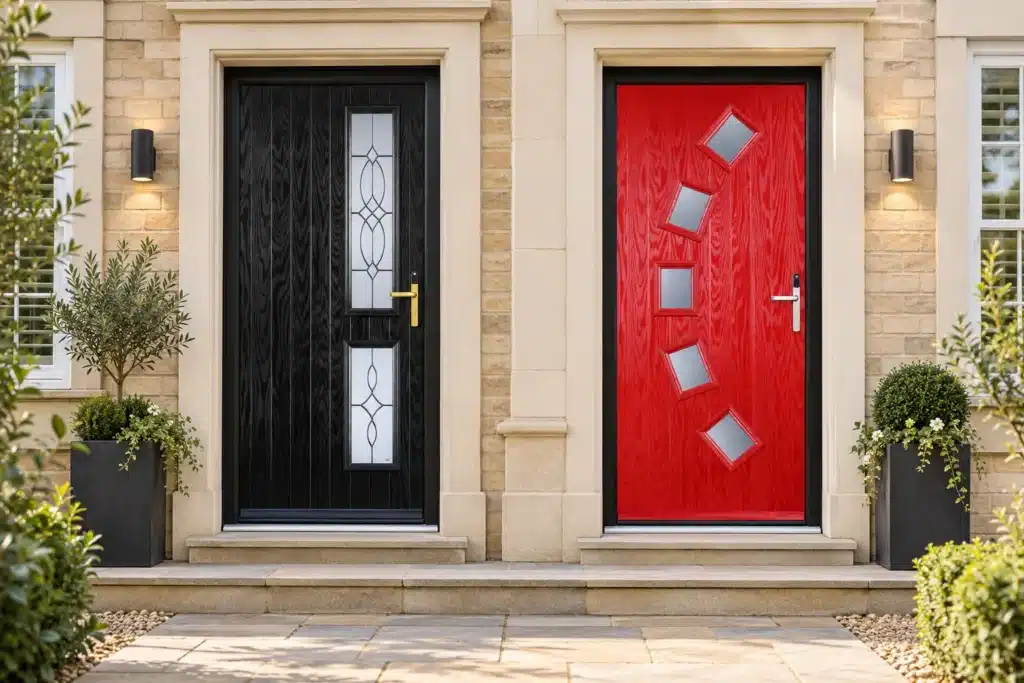
Composite doors are not restricted to one traditional panel design. Window Mart’s designer groups its doors into five ranges: Traditional, Modern, Contemporary, Cottage and Flush Grained. Each range includes different panel and glazing layouts.
Traditional composite doors
Traditional designs use recognisable panel shapes and smaller areas of glass. Options in the designer include 2 Panel 2 Arch, 2 Panel 2 Angle, 2 Panel 2 Square, 4 Panel 1 Arch, 6 Panel and sunburst designs. These styles work well where you want a familiar front-door appearance rather than a completely flat slab.
Modern and contemporary composite doors
Modern and contemporary doors tend to use cleaner lines, simpler panels and bolder glazing. They suit newer homes, renovated entrances and homeowners who want the front door to contrast with traditional brickwork.
Cottage and flush-grained doors
Cottage styles have a more informal, rural character. Flush-grained doors reduce the amount of moulded panel detail and give the entrance a plainer finish. The best way to compare them is to apply the same colour and glazing choice to several styles in the Door Designer.
Composite door styles vs traditional wooden door styles: which is better for insulation?
A well-specified composite door is generally the more predictable choice for insulation because it is manufactured as a complete door system with an insulated structure, frame, seals and threshold. A wooden door can also perform well, but its results depend on the timber construction, thickness, glazing, condition and how accurately it fits the frame.
Style alone does not decide insulation. A heavily glazed door may perform differently from a mostly solid design, and poor fitting can create draughts around any door. When comparing quotations, ask for the whole-door U-value for the exact style and glazing specification rather than relying on a general statement about the material.
What else affects a front door’s insulation?
- The construction of the door slab
- The amount and specification of the glazing
- The frame, seals and threshold
- Accurate surveying and installation
- Correct adjustment of the hinges and locking points
How secure are composite doors?
The Window Mart configurator describes its composite-door specification as high security and shows a Yale Lockmaster in the technical options. Security still depends on the complete specification, including the lock, cylinder, hinges, letterplate, glazing and installation.
Hardware options include lever handles, lever pads, a TS008 letterplate, spyholes, security chains and thumbturns. The designer also offers Yale Conexis and an Ultion cylinder as optional security upgrades. Because these are upgrades, they should not be assumed to come as standard on every door. Window Mart can confirm the final lock and cylinder specification during quotation and survey.
Which glass should you choose for a composite door?
Front-door glass affects privacy, daylight and the character of the entrance. Patterned glass obscures the view through the door while still admitting light. Clear glass gives the brightest view but provides less privacy unless the door faces a private area.
Pattern choices in the designer include Satin, Everglade, Chantilly, Charcoal Sticks, Oak, Pelerine, Taffeta, Florielle, Mayflower, Contora, Digital, Cotswold, Stippolyte, Autumn and Minster. Decorative designs include Finesse, Classic, Flair, Brass Art Clarity, Zinc Art Elegance and Zinc Art Abstract.
Think about the view from the pavement as well as the view from your hallway. A decorative design may become the main feature of a simple door, while a strong door colour often works better with quieter glass.
What frame and threshold options are available?
The technical section of the designer includes a VEKA Chamfered profile and a choice of full-frame, low-frame, wheelchair and wheelchair MDS25 thresholds. It also allows inward or outward opening, left- or right-hand hinging and different cill sizes. These details are confirmed during the survey because measurements, floor levels and access requirements vary from one property to another.
How to use the Window Mart Composite Door Designer
- Choose a standard door or add side panels and a top box.
- Select Traditional, Modern, Contemporary, Cottage or Flush Grained.
- Pick separate internal and external door colours.
- Choose the frame finish.
- Compare patterned and decorative glazing.
- Select hardware and any security upgrades.
- Enter approximate dimensions and review the indicative price.
The dimensions do not need to be exact at this stage. A Window Mart representative carries out a full survey before the order is finalised. Our guide to choosing a composite door installer in Horsham explains what to expect from surveying, fitting and guarantees.
Composite door FAQs
What is the most popular colour for a composite front door?
Black, grey, blue, green and white are widely chosen because they suit many UK brick and render colours. Heritage shades such as Chartwell Green and Agate Grey are useful when a softer finish is needed.
Can the inside of a composite door be white?
Yes. Window Mart’s designer lets you choose the internal and external colours separately, so a coloured exterior can have a white interior.
Are composite doors better insulated than wooden doors?
Composite doors usually provide more predictable insulation because the slab, frame, seals and threshold are designed as one system. A well-made and well-fitted wooden door can also insulate effectively. Compare the whole-door U-value for the exact products.
Are Ultion locks standard on Window Mart composite doors?
The online designer lists an Ultion cylinder as an optional upgrade. Ask Window Mart to confirm the standard cylinder and any upgrade cost for your chosen door.
Can I add a side panel to a composite door?
Yes. The designer includes right, left and double side-panel configurations, plus top boxes and combinations of top boxes with side panels.
Does decorative glass reduce privacy?
It depends on the design. Patterned and obscured glass generally provides more privacy than clear glass. Check the full-size sample and consider the position of the door relative to the road or neighbouring properties.
Does the Door Designer price include every possible requirement?
The designer provides an indicative price based on the options and approximate measurements entered. Window Mart completes a property survey to confirm the measurements, specification and final quotation.
Compare your options before choosing
A front door is easier to choose when you can see the colour, glass and hardware together. Build several versions in the online designer, save screenshots of the combinations you like and compare them against the front of your house. Window Mart can then confirm the technical details and final measurements during the survey. When you are ready, contact Window Mart for advice and a free no-obligation quotation.